Japan Inheritance Tax Abroad: The 10-Year Rule & Estate Planning
Japanese inheritance tax (Sozokuzei 相続税) can reach property anywhere in the world, and moving abroad does not end that reach on the day you leave. Whether overseas assets are taxed depends on the nationality and Japan address history of both the person who dies and each heir, and on the heir’s residence status if they live in Japan. This guide covers the taxpayer categories, the 10-year rule, gift tax, double tax relief, cross-border wills and forced heirship, and the filing duties of heirs abroad.
Why Japan’s Inheritance Tax Reaches So Far Abroad
Section titled “Why Japan’s Inheritance Tax Reaches So Far Abroad”An Heir-Based Tax with Worldwide Reach
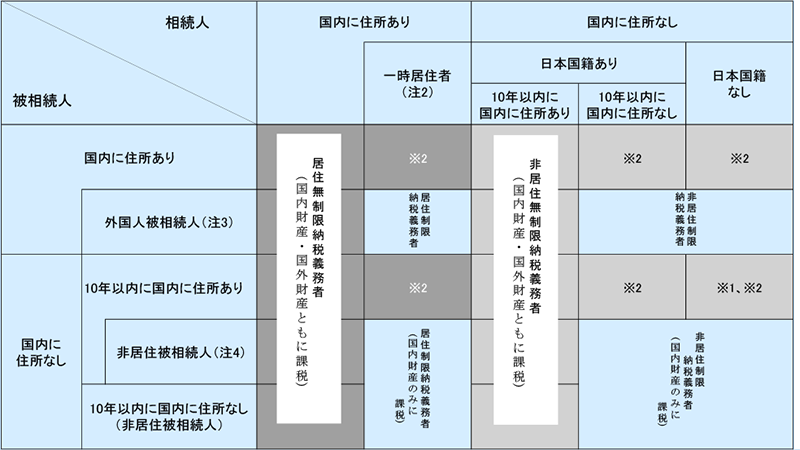
Section titled “An Heir-Based Tax with Worldwide Reach”Japanese inheritance tax is charged on each person who acquires property, not on the estate as a whole. Article 1-3 of the Inheritance Tax Act (Sozokuzei Ho 相続税法) sorts every heir and legatee into a taxpayer class: unlimited taxpayers pay on all property acquired, wherever it is, and limited taxpayers only on property situated in Japan (Article 2).1 The National Tax Agency (NTA) summarises the classes in Tax Answer No.4138.23
Two facts decide the class: address and nationality, both judged when the property is acquired.4 An address (Jusho 住所) means the base of a person’s life, judged on objective facts.5 How that test applies to leavers, including the Takefuji gift tax judgment, is covered in the guide to long-term relocation versus temporary stay.
People who are only temporarily away can keep a Japan address. NTA 4138 says in one line that people away for study or business trips are treated as living in Japan.2 The underlying Basic Circular 1の3・1の4共-6 is narrower: it covers only Japanese nationals and Permanent Residents studying abroad as dependants of someone in Japan, or posted abroad for about a year or less (with household members), unless their address is clearly outside Japan.5
Rates, Basic Deduction and Surcharge
Section titled “Rates, Basic Deduction and Surcharge”The basic deduction is ¥30 million plus ¥6 million for each statutory heir (as of October 2026).16 Tax is computed by notionally dividing the taxable estate among the statutory heirs by their statutory shares and applying the progressive rates below to each share (as of October 2026).17
| Amount per statutory share | Rate | Quick deduction |
|---|---|---|
| Up to ¥10M | 10% | 0 |
| ¥10M to ¥30M | 15% | ¥0.5M |
| ¥30M to ¥50M | 20% | ¥2M |
| ¥50M to ¥100M | 30% | ¥7M |
| ¥100M to ¥200M | 40% | ¥17M |
| ¥200M to ¥300M | 45% | ¥27M |
| ¥300M to ¥600M | 50% | ¥42M |
| Over ¥600M | 55% | ¥72M |
Two adjustments matter for many families (as of October 2026). The spouse, first-degree blood relatives and descendants (such as grandchildren) inheriting by representation pay the normal tax; every other acquirer, including a grandchild adopted as a child who is not inheriting by representation, pays 20% more.18 The spouse pays no tax on acquisitions up to the greater of ¥160 million or the spouse’s statutory share, for property divided by the filing deadline or within 3 years after it with the required statement.19
How the Rules Got Here: 2017 and 2021 Reforms
Section titled “How the Rules Got Here: 2017 and 2021 Reforms”Japan has widened and narrowed its reach several times. The FY2000 reform extended worldwide taxation to people who had left Japan within 5 years, and for property acquired on or after 1 April 2017 that period became 10 years.1011 The 2021 reform then removed the length-of-stay test for foreign nationals on a Table 1 status who die in Japan (previously 10 years or less in the last 15), for inheritances from 1 April 2021.10124
Many pages still describe older rules. A 2017 transitional rule for “non-resident foreign nationals” (Hikyoju Gaikokujin 非居住外国人) covered only acquisitions up to 31 March 2022, although NTA 4138 and 4102 still mention the term.21013
The 10-Year Rule Explained: When Overseas Assets Leave Japan’s Tax Net
Section titled “The 10-Year Rule Explained: When Overseas Assets Leave Japan’s Tax Net”The Four Taxpayer Categories (Article 1-3)
Section titled “The Four Taxpayer Categories (Article 1-3)”Article 1-3 creates four main classes, plus a fifth for people who receive only settlement-taxation gifts (Tokutei Nozei Gimusha 特定納税義務者), taxed only on those gifts.13
| Class (NTA label) | Who | Taxed on |
|---|---|---|
| Resident unlimited (居住無制限納税義務者) | Japan address; not a temporary resident, or a temporary resident whose decedent is neither a foreign national decedent nor a non-resident decedent | Worldwide property |
| Non-resident unlimited (非居住無制限納税義務者) | No Japan address; caught by the nationality tests below | Worldwide property |
| Resident limited (居住制限納税義務者) | Japan address; not unlimited | Japan-situs property only |
| Non-resident limited (非居住制限納税義務者) | No Japan address; not unlimited | Japan-situs property only |
Japanese-National Heirs Living Abroad
Section titled “Japanese-National Heirs Living Abroad”A Japanese-national heir abroad is an unlimited taxpayer if they had a Japan address at any time in the 10 years before the death, whoever the decedent was (Article 1-3(1)(ii)(イ)(1)).12 The test is not “more than 10 years abroad” counted from a departure date, and dual nationals who hold Japanese nationality are on this track.15
A Japanese heir with no Japan address in those 10 years is still unlimited, unless the decedent was a “foreign national decedent” or a “non-resident decedent”.1 This is the source of the familiar “both decedent and heir out of Japan for 10 years” shorthand, and it applies only to Japanese-national heirs.12
Non-Japanese Heirs Living Abroad
Section titled “Non-Japanese Heirs Living Abroad”A non-Japanese heir living abroad has no lookback on their own residence: they are unlimited unless the decedent was a foreign national decedent or a non-resident decedent (Article 1-3(1)(ii)(ロ)).12 So a non-Japanese child abroad who never lived in Japan is taxed on worldwide inherited property if the parent was a Japanese national or Permanent Resident living in Japan at death.12
Who Is a “Non-Resident Decedent” (非居住被相続人)
Section titled “Who Is a “Non-Resident Decedent” (非居住被相続人)”A non-resident decedent had no Japan address at death and meets one of two limbs (Article 1-3(3)(iii)).1 Under limb (a), they had a Japan address at some time in the 10 years before death but held no Japanese nationality at any of those times; under limb (b), they had no Japan address at any time in those 10 years.12
So a former Permanent Resident who dies abroad even a year after leaving qualifies under limb (a), while a Japanese national, including one naturalised while living in Japan within the 10 years, needs limb (b).1
Exit-Tax Deferral Users: The Deemed 10-Year Address (Article 1-3 Paragraph 2)
Section titled “Exit-Tax Deferral Users: The Deemed 10-Year Address (Article 1-3 Paragraph 2)”A decedent who used the exit-tax payment deferral on departure (Income Tax Act Article 137-2) is deemed to have had a Japan address within the 10 years before death.114 The deeming applies only to the items that turn on the decedent’s status, and parallel rules cover deferred gifts and inheritances (Article 137-3); all apply to acquisitions on or after 1 July 2015.110 NTA flags the affected cells with ※ in its table; the exit tax itself is covered in the guide to Japan’s departure tax.215
Tax Liability Matrix: Decedent Status vs. Heir Status (Citizens vs. Foreign Residents)
Section titled “Tax Liability Matrix: Decedent Status vs. Heir Status (Citizens vs. Foreign Residents)”The table combines Article 1-3 with the NTA 4138 table.124 “W” means worldwide (unlimited taxpayer) and “J” means Japan-situs property only (limited taxpayer); the table assumes no exit-tax deferral, with which some J cells can become W.12
| Decedent at death | Heir in Japan, not a temporary resident | Heir in Japan, temporary resident (Table 1, 10 of last 15 years or less) | Heir abroad, Japanese, Japan address within 10 years | Heir abroad, Japanese, no Japan address within 10 years | Heir abroad, non-Japanese |
|---|---|---|---|---|---|
| Japan address; Japanese national, Table 2 holder or other non-Table-1 person | W | W | W | W | W |
| Japan address; Table 1 status (foreign national decedent) | W | J | W | J | J |
| Abroad; had a Japan address within 10 years while Japanese at some such time | W | W | W | W | W |
| Abroad; non-resident decedent (limb a or b) | W | J | W | J | J |
flowchart TD
    A["Heir has a Japan address when acquiring?"] -->|Yes| B["Heir is a temporary resident? (Table 1 status and 10 of last 15 years or less)"]
    B -->|No| W1["Resident unlimited: worldwide"]
    B -->|Yes| D1["Decedent is a foreign national decedent or non-resident decedent?"]
    D1 -->|No| W2["Resident unlimited: worldwide"]
    D1 -->|Yes| J1["Resident limited: Japan-situs only"]
    A -->|No| C["Heir holds Japanese nationality?"]
    C -->|Yes| E["Heir had a Japan address within 10 years before the death?"]
    E -->|Yes| W3["Non-resident unlimited: worldwide"]
    E -->|No| D2["Decedent is a foreign national decedent or non-resident decedent?"]
    C -->|No| D2
    D2 -->|No| W4["Non-resident unlimited: worldwide"]
    D2 -->|Yes| J2["Non-resident limited: Japan-situs only"]
Table 1 vs. Table 2 Residence Status: Temporary Residents (一時居住者)
Section titled “Table 1 vs. Table 2 Residence Status: Temporary Residents (一時居住者)”A temporary resident heir must pass two tests at once. They hold a status listed in Appended Table 1 of the Immigration Control Act at the start of the inheritance, and they had a Japan address for 10 years or less in total during the previous 15 years.1 The test counts address periods, not years on a visa, so a Table 1 holder in Japan for more than 10 of the last 15 years is not a temporary resident.1
Table 1 covers activity-based statuses such as Engineer/Specialist in Humanities/International Services, Intra-company Transferee, Student and Dependent.16 Table 2 has only four statuses: Permanent Resident (永住者), Spouse or Child of Japanese National (日本人の配偶者等), Spouse or Child of Permanent Resident (永住者の配偶者等) and Long-Term Resident (定住者). Holders of a Table 2 status are never temporary residents, however short their stay.116
Special Permanent Residents (特別永住者) hold their status under a separate 1991 Special Act, not Table 1.17 On the statutory wording they would therefore get neither carve-out, but no NTA statement confirms this, so check with the tax office or a Zeirishi.
Foreign National Decedents Living in Japan (外国人被相続人)
Section titled “Foreign National Decedents Living in Japan (外国人被相続人)”A foreign national decedent holds a Table 1 status and has a Japan address at death, with no length-of-stay test since 1 April 2021.110 Heirs who are temporary residents, non-Japanese heirs abroad and Japanese heirs abroad with no Japan address in the past 10 years are limited taxpayers; every other heir stays unlimited.12
A Permanent Resident or other Table 2 holder who dies in Japan is not a foreign national decedent, so all of their heirs, including non-Japanese heirs abroad who never lived in Japan, are unlimited taxpayers.12
Worked Scenarios
Section titled “Worked Scenarios”Each scenario assumes no exit-tax deferral and clear address facts.12
| Scenario | Decedent status | Result for the heirs named |
|---|---|---|
| Japanese retiree dies in Malaysia after 6 years there; children live in Japan | Not a non-resident decedent (Japan address within 10 years) | Children: resident unlimited, worldwide |
| Japanese retiree abroad 11 years; Japanese child abroad 12 years | Non-resident decedent (limb b) | Child: Japan-situs only; worldwide if the child had a Japan address within the 10 years |
| Foreign Permanent Resident leaves Japan and dies abroad 2 years later | Non-resident decedent (limb a) | Non-Japanese children abroad: Japan-situs only; Japanese-national child abroad for 5 years: worldwide; child in Japan who is not a temporary resident: worldwide |
| Table 1 engineer dies in Japan | Foreign national decedent | Table 1 spouse with 10 of 15 years or less in Japan: Japan-situs only; spouse with more than 10 of 15 years: worldwide; non-Japanese children abroad: Japan-situs only |
| Foreign Permanent Resident dies in Japan | Table 2 holder, not a foreign national decedent | All heirs, including non-Japanese heirs abroad: worldwide |
Gift Tax Runs on Parallel Rules: Lifetime Gifts and the 7-Year Add-Back
Section titled “Gift Tax Runs on Parallel Rules: Lifetime Gifts and the 7-Year Add-Back”Gift Tax Taxpayer Categories (Article 1-4)
Section titled “Gift Tax Taxpayer Categories (Article 1-4)”Gift tax (Zoyozei 贈与税) uses the same structure, with the donor in place of the decedent and the 10 years counted back from the gift.1 Article 1-4 defines a foreign national donor (外国人贈与者) and a non-resident donor (非居住贈与者) on the same lines, and donees abroad file through a tax agent.115 The annual exclusion under calendar-year taxation is ¥1.1 million (as of October 2026).18
Gifts Within 7 Years of Death Are Added Back (Article 19)
Section titled “Gifts Within 7 Years of Death Are Added Back (Article 19)”An heir or legatee adds to their inheritance tax base the calendar-year gifts received from the decedent within 7 years before death, with credit for the gift tax paid.1 Gifts made more than 3 years before death are reduced by ¥1 million in total, and the add-back applies only to people who acquire property from the decedent by inheritance, bequest or settlement-taxation gift.119
The 7-year window applies only to gifts made on or after 1 January 2024, so it is being phased in (as of October 2026):1019
- Deaths up to 31 December 2026: gifts within 3 years before death.
- Deaths from 1 January 2027 to 31 December 2030: gifts from 1 January 2024 to the date of death.
- Deaths from 1 January 2031: gifts within the full 7 years before death.
NTA notes that the ¥1 million reduction matters only for deaths on or after 2 January 2027.19 Gifts under the settlement taxation system (Sozokuji Seisan Kazei 相続時精算課税) are always added back at death, whenever they were made, although for gifts from 1 January 2024 the amount is net of that system’s annual ¥1.1 million basic deduction (as of October 2026).3132018 Under Article 21-9 the system is open to lineal-descendant presumptive heirs aged 18 or over receiving from donors aged 60 or over, and the election cannot be withdrawn.1
Gifts to Non-Resident Children: Exit-Tax and Remittance Flags
Section titled “Gifts to Non-Resident Children: Exit-Tax and Remittance Flags”Two other regimes can apply to gifts to children abroad. A gift of covered assets to a non-resident by a resident of Japan holding ¥100 million or more of such assets can trigger the exit tax on gifts (Income Tax Act Article 60-3), covered in the guide to Japan’s departure tax.14 Remittance reporting is covered in the guide to international money transfers from Japan.
The Problem of Probate: Common Law Wills vs. Japanese Civil Law Inheritance
Section titled “The Problem of Probate: Common Law Wills vs. Japanese Civil Law Inheritance”Which Country’s Law Governs Succession (通則法 Articles 36 to 38, 41)
Section titled “Which Country’s Law Governs Succession (通則法 Articles 36 to 38, 41)”Japan applies the decedent’s national law to succession (Act on General Rules for Application of Laws, Ho no Tekiyo ni Kansuru Tsusoku Ho 法の適用に関する通則法, Article 36).21 The formation and effect of a will follow the testator’s national law when it was made, and revocation follows the national law at the time of revocation (Article 37).21 If one of a person’s nationalities is Japanese, Japanese law is their national law (Article 38(1)); nationality choices themselves are covered in the guide to dual citizenship for Japanese children.21
Renvoi applies to succession: if the decedent’s national law refers the question back to Japanese law, Japanese law applies (Article 41).21 Whether a foreign law refers back is a question of that law, and for countries with several legal regions, such as the US, that country’s rules pick the region (Article 38(3)).21
Will Formalities: Making a Will Abroad That Japan Recognises
Section titled “Will Formalities: Making a Will Abroad That Japan Recognises”Japan treats a will as formally valid if it meets the rules of any one of several laws (Act on the Law Applicable to the Form of Wills, Act No. 100 of 1964, Article 2): the place where it was made, a nationality, domicile or habitual residence held when it was made or at death, or, for immovables, their location.22 The Act implements the 1961 Hague Form of Wills Convention, in force for Japan since 2 August 1964.23 Japan is not a party to the Hague Trusts Convention, and the 1989 Hague Succession Convention has not entered into force.2425
The Civil Code (Minpo 民法) offers three ordinary forms: holographic (自筆証書), notarial (公正証書) and secret (秘密証書).26 Under current Article 968, the full text, date and name of a holographic will must be handwritten and sealed, although a typed property list is allowed if each page is signed and sealed; a notarial will needs two or more witnesses and is drawn up by a notary (as of October 2026).26 Japanese nationals abroad can make a notarial or secret will before a Japanese consul acting as notary (Article 984).26
Changes have been enacted but are not yet in force. Act No. 45 of 2026, promulgated on 24 June 2026, makes the seal on holographic wills optional from a date set by cabinet order no later than 23 June 2027, and creates a “custody-certificate will” (保管証書遺言) from a date no later than 23 June 2029.2728 The new will, on paper or electronic, is read aloud before a will-custody officer at a Legal Affairs Bureau; neither start date had been fixed (as of October 2026), and wills made before the seal change stay under the old rule.2728
The Ministry of Justice has stored holographic wills at Legal Affairs Bureaus since 10 July 2020: application is in person, the fee is ¥3,900 per will, and a foreign-language will needs a Japanese translation (as of October 2026).2930 The Ministry does not say whether someone abroad with no Japanese resident record can apply, so check with the bureau before travelling.30
Forced Heirship: Iryubun and Common Law Freedom of Testation
Section titled “Forced Heirship: Iryubun and Common Law Freedom of Testation”Japanese law reserves part of the estate (Iryubun 遺留分) for heirs other than siblings. The reserve is 1/3 of the base where only parents or other ascendants inherit and 1/2 otherwise, divided by statutory shares (Civil Code Articles 1042 and 900).26 For successions from 1 July 2019, a holder whose reserve is infringed claims a sum of money from legatees and donees rather than the property itself (Article 1046).2631
The claim expires 1 year after the holder learns of the inheritance and of the infringing gift or bequest, and in any case 10 years after the death (Article 1048).26 When a reserved-share payment is settled, the parties may request a correction of their inheritance tax within 4 months (Inheritance Tax Act Article 32).1
Because Japan’s conflict rules apply national law, Iryubun applies to the estates of Japanese nationals, including dual nationals, even if they live and die abroad.21 Other legal systems may give testators more freedom, so have a will drafted for one system checked under the other.
Probate Abroad vs. Japan’s Non-Probate Transfer
Section titled “Probate Abroad vs. Japan’s Non-Probate Transfer”Japan’s court step for wills is inspection, not probate. The holder of a will must submit it to the family court for inspection (Kenin 検認) without delay after learning of the death, although notarial wills and wills stored with the Ministry of Justice service are exempt (Civil Code Article 1004; Will Custody Act Article 11).2629 Heirs record the division in an estate division agreement (Isan Bunkatsu Kyogisho 遺産分割協議書), and the NTA asks for each heir’s seal certificate to be attached when spousal relief is claimed;9 heirs abroad generally use signature certificates instead, as explained in the guide to the moving-out notification.
Common law countries work differently. In England and Wales, for example, the executor named in the will applies for probate, “the legal right to deal with someone’s property, money and possessions”, and the original will becomes a public record.32
Avoiding Double Inheritance Taxation: The Foreign Tax Credit (Article 20-2)
Section titled “Avoiding Double Inheritance Taxation: The Foreign Tax Credit (Article 20-2)”How the Credit Works and Its Pro-Rata Cap
Section titled “How the Credit Works and Its Pro-Rata Cap”Article 20-2 (在外財産に対する相続税額の控除) gives a credit when property situated outside Japan is also taxed abroad.1 A tax equivalent to inheritance tax imposed under the law of the place where the property is gets deducted from the Japanese tax, capped at the Japanese tax multiplied by the foreign property’s value over the taxable value of everything acquired (both net of related debts).133 The credit is applied last, after the gift tax credit, spousal relief and the other credits.33
There is no credit for foreign tax charged on property situated in Japan.1 Foreign tax is converted into yen at the TTS rate on its payment due date, or at the remittance date unless remittance is significantly delayed.33 Neither the statute nor NTA guidance addresses foreign tax assessed after the Japanese deadline, so ask a Zeirishi whether a correction request is available.134
Situs rules (Article 10) decide which side of the line each asset falls on, judged at the time of acquisition.12
| Asset | Situated where |
|---|---|
| Real estate and movables | Where the property is |
| Deposits | The branch that accepted the deposit |
| Insurance proceeds | The insurer’s head office; if it has no head office in Japan but a Japan office handles the contract, that office |
| Shares and corporate bonds | The issuer’s head office |
| Government bonds | Japanese government and local bonds: Japan; foreign government bonds: that country |
| Loans receivable | The debtor’s address |
| Retirement allowances | The payer’s address or head office |
| Investment trusts | The office that accepted the trust |
| Other property | The decedent’s address |
Foreign assets are valued under the Property Valuation Basic Circular, and foreign-currency values are converted at the TTB rate of the taxpayer’s bank on the taxation date (TTS for debts).35
The Japan-US Estate and Gift Tax Convention
Section titled “The Japan-US Estate and Gift Tax Convention”Japan’s published treaty lists cover income tax treaties; the 1954 convention with the United States is the one estate and gift tax treaty Japan is known to have.363738 A US bibliographic record dates its entry into force to 1955, and Japan implements it through Act No. 194 of 1954.363940
The IRS lists Japan as an estate and gift tax treaty partner, and its Form 706-NA instructions name the Japan treaty among those allowing a treaty-based unified credit for nonresident non-citizen estates.3841 The convention’s situs and credit articles were not checked against an official text for this guide, so read it with a US-qualified adviser.
US rules also apply in their own right. A nonresident non-citizen’s estate must file Form 706-NA if US-situated assets exceed USD 60,000, and US citizens are taxed on worldwide assets wherever they live (as of October 2026).42 US probate and estate tax for US residents are outside this guide’s scope, so check them with a US-qualified adviser.
Countries Without Inheritance Tax and Countries with Different Systems
Section titled “Countries Without Inheritance Tax and Countries with Different Systems”Where the other country levies no tax equivalent to inheritance tax, there is nothing to credit, and the Japanese tax stands in full.1 Japan’s tax falls on each heir, while estate-type taxes such as the US federal estate tax fall on the estate.142
Structuring Cross-Border Assets: Trusts, Life Insurance, and Holding Companies
Section titled “Structuring Cross-Border Assets: Trusts, Life Insurance, and Holding Companies”Life Insurance Proceeds as Deemed Inheritance (Article 3, Article 12)
Section titled “Life Insurance Proceeds as Deemed Inheritance (Article 3, Article 12)”Death proceeds of life insurance are deemed inherited property, in proportion to the premiums the decedent paid (Article 3).143 Proceeds received by heirs are exempt up to ¥5 million times the number of statutory heirs, but heirs who renounced and non-heirs get no exemption (Article 12) (as of October 2026).143 A policy with a foreign insurer is foreign-situs only if no Japan office handles the contract (Article 10).1
Trusts: Beneficiaries Are Treated as Owning Trust Assets (Articles 9-2 to 9-6)
Section titled “Trusts: Beneficiaries Are Treated as Owning Trust Assets (Articles 9-2 to 9-6)”Japan looks through trusts to their beneficiaries. A person who becomes a beneficiary without paying fair value is deemed to acquire the trust rights from the settlor, by gift or, if the trust takes effect on the settlor’s death, by bequest, and is treated as owning the trust’s assets and liabilities (Article 9-2).1 The rules have no foreign-trust exception, but whether a foreign arrangement counts as a trust under the Act is fact-specific, so ask a Zeirishi.1
Holding Companies: Shares Are Still Inherited Property
Section titled “Holding Companies: Shares Are Still Inherited Property”Shares are situated where the issuing company has its head office, so shares in a foreign holding company are foreign-situs property, taxed for unlimited taxpayers like any other overseas asset.1 They are valued under the Property Valuation Basic Circular.35 Japan’s CFC rules on foreign companies owned by residents are covered in the guide to incorporating a company abroad.
Designating an International Estate Executor
Section titled “Designating an International Estate Executor”Will Executors (遺言執行者) Under the Civil Code
Section titled “Will Executors (遺言執行者) Under the Civil Code”A testator may name one or more executors (Igon Shikkosha 遺言執行者) in the will, or leave the choice to a third party (Civil Code Article 1006).26 The executor must tell the heirs the will’s contents without delay after accepting and alone performs bequests (Articles 1007 and 1012); if none is named, the family court can appoint one on application (Article 1010).26
Coordinating Executors and Personal Representatives in Two Countries
Section titled “Coordinating Executors and Personal Representatives in Two Countries”A later will revokes the conflicting parts of an earlier one (Civil Code Article 1023).26 A will made abroad with a general revocation clause, or with conflicting terms, can therefore override a Japanese will to that extent, subject to the national law at the time of revocation (通則法 Article 37(2)) and the Form of Wills Act.2122 If you keep separate wills for different countries, ask lawyers in each to check that neither revokes the other.
Step-by-Step Administrative Procedure & Timeline
Section titled “Step-by-Step Administrative Procedure & Timeline”Lifetime checks that follow from the rules above (no statute requires them):122
- List assets by country and by situs (Article 10), and keep dated records of lifetime gifts and of any exit-tax deferral.
- Map each family member’s taxpayer class (Article 1-3) and recheck after every move and when a 10-year or 15-year window closes.
- Check each will against the Form of Wills Act and the 2026 Civil Code changes.
After a death, the main Japanese deadlines run as follows:
| When | Step | Basis |
|---|---|---|
| Without delay | Submit a holographic will for family court inspection, unless notarial or stored with the Ministry of Justice | Civil Code Article 100426 |
| Within 3 months of learning the inheritance has started for you | Renounce or accept with limitation (the family court can extend) | Civil Code Article 91526 |
| Within 4 months from the day after learning of the inheritance (earlier if the heir leaves Japan) | Quasi-final income tax return for the decedent, where required | Income Tax Act Article 12514 |
| Before filing, or before leaving Japan | Heirs without a Japan address appoint a tax agent and choose a place for tax payment | 国税通則法 Article 117; Inheritance Tax Act Article 62441 |
| Within 10 months from the day after learning of the death | Inheritance tax return and payment | Inheritance Tax Act Article 27120 |
A death on 6 January, for example, gives a filing deadline of 6 November (as of October 2026).20 A return is needed only where the taxable value, including add-backs, exceeds the basic deduction; if the decedent lived in Japan it goes to the tax office for the decedent’s address, and a filer leaving Japan within the 10 months without notifying a tax agent must file by the departure date.120
Heirs abroad who must file appoint a tax agent (Nohzei Kanrinin 納税管理人) with an address or residence in Japan (Act on General Rules for National Taxes Article 117), as covered in the guide to appointing a tax agent.442
Japanese Citizens vs. Foreign Residents: Critical Distinctions
Section titled “Japanese Citizens vs. Foreign Residents: Critical Distinctions”| Point | Japanese nationals (including dual nationals) | Foreign nationals |
|---|---|---|
| Heir living abroad | Unlimited if they had a Japan address within the 10 years before the death1 | No own lookback; depends only on the decedent’s status1 |
| Decedent living abroad | Non-resident decedent only after 10 years with no Japan address1 | Non-resident decedent once they have no Japan address, if never Japanese while resident within the 10 years1 |
| Living in Japan | Always unlimited1 | Table 1 holders: temporary-resident and foreign-national-decedent carve-outs; Table 2 holders: unlimited1 |
| Temporary absence presumption (Circular 共-6) | Applies5 | Applies to Permanent Residents only5 |
| Law governing succession | Japanese law, including Iryubun21 | National law, subject to renvoi21 |
| Consular wills abroad | Available (Civil Code Article 984)26 | Not available26 |
Common Pitfalls & Regulatory Compliance Risks
Section titled “Common Pitfalls & Regulatory Compliance Risks”- Applying “both out for 10 years” to non-Japanese heirs. Fix: use the decedent’s status alone for non-Japanese heirs abroad.1
- Assuming Permanent Residency or a spouse visa gives the Table 1 carve-out. Fix: Table 2 holders get none.116
- Assuming every Table 1 holder is a temporary resident. Fix: apply the 10-of-15-year address test.1
- Relying on the expired “non-resident foreign national” category shown on NTA pages. Fix: it covered only acquisitions up to 31 March 2022.10
- Forgetting the gift add-back. Fix: the window is 3 years for deaths in 2026 and widens from 2027.19
- Overlooking an exit-tax deferral. Fix: Article 1-3(2) deems a Japan address within 10 years.1
- Missing the 10-month deadline or filing without a tax agent. Fix: appoint one early.144
- Treating foreign trusts or foreign-insurer policies as automatically outside Japanese tax. Fix: check the trust rules and the Japan-office situs proviso.1
See also
Section titled “See also”Retirement and pensions abroad
- Retiring Abroad on a Japanese Pension: Budgets & Destinations: planning a retirement overseas, whose timing affects the 10-year windows explained above.
- Receiving Your Japanese Pension Overseas: Expat & Retiree Guide: how pension payments continue after you leave Japan.
Cross-border tax and finance
- Japan Tax Residency: Resident vs Non-Resident (Hi-kyojusha) Rules: the income tax residence test, which uses the same address concept as the inheritance tax classes.
- Keeping Japanese Bank & Brokerage Accounts After Moving Abroad: the Japan-situs deposits and securities that heirs abroad often inherit.
Global investment and business
- Buying Overseas Property from Japan: Foreign Buyer Rules & Tax: how overseas real estate is taxed and valued, including its inheritance tax exposure.
References & Official Sources
Section titled “References & Official Sources”Footnotes
Section titled “Footnotes”-
e-Gov, 相続税法 (Inheritance Tax Act, Act No. 73 of 1950), current revision 325AC0000000073_20260401_506AC0000000008 (in force 1 April 2026), Articles 1-3, 1-4, 2, 2-2, 3, 9-2 to 9-6, 10, 12, 15, 16, 18, 19, 19-2, 20-2, 21-5, 21-9, 21-11-2, 27, 32, 62; the next revision (1 January 2027) shows no change to these articles, accessed October 2026, https://laws.e-gov.go.jp/api/2/law_data/325AC0000000073 (human-readable: https://laws.e-gov.go.jp/law/325AC0000000073) ↩ ↩2 ↩3 ↩4 ↩5 ↩6 ↩7 ↩8 ↩9 ↩10 ↩11 ↩12 ↩13 ↩14 ↩15 ↩16 ↩17 ↩18 ↩19 ↩20 ↩21 ↩22 ↩23 ↩24 ↩25 ↩26 ↩27 ↩28 ↩29 ↩30 ↩31 ↩32 ↩33 ↩34 ↩35 ↩36 ↩37 ↩38 ↩39 ↩40 ↩41 ↩42 ↩43 ↩44 ↩45 ↩46 ↩47 ↩48 ↩49 ↩50 ↩51 ↩52 ↩53 ↩54 ↩55 ↩56 ↩57 ↩58 ↩59 ↩60 ↩61
-
National Tax Agency, Tax Answer No.4138 「相続人が外国に居住しているとき」 (令和8年4月1日現在法令等), including the taxpayer table image and notes 1 to 6, accessed October 2026, https://www.nta.go.jp/taxes/shiraberu/taxanswer/sozoku/4138.htm (table image: https://www.nta.go.jp/taxes/shiraberu/taxanswer/sozoku/img/4138.png) ↩ ↩2 ↩3 ↩4 ↩5 ↩6 ↩7 ↩8 ↩9 ↩10 ↩11 ↩12 ↩13 ↩14 ↩15 ↩16
-
National Tax Agency, Tax Answer No.4138 Q&A 「相続税の納税義務者の範囲等」, accessed October 2026, https://www.nta.go.jp/taxes/shiraberu/taxanswer/sozoku/4138_qa.htm ↩ ↩2 ↩3
-
National Tax College (NTA), 相続税法(基礎編)令和8年度版, Chapter 2 納税義務者 (pages 6 to 9), accessed October 2026, https://www.nta.go.jp/about/organization/ntc/kohon/souzoku/pdf/all.pdf ↩ ↩2 ↩3
-
National Tax Agency, 相続税法基本通達 第1条の3・第1条の4共通関係 (1の3・1の4共-5 「住所」の意義, 共-6 国外勤務者等の住所の判定, 共-7 重国籍者), accessed October 2026, https://www.nta.go.jp/law/tsutatsu/kihon/sisan/sozoku2/01/01.htm ↩ ↩2 ↩3 ↩4 ↩5
-
National Tax Agency, Tax Answer No.4152 「相続税の計算」 (令和8年4月1日現在法令等), accessed October 2026, https://www.nta.go.jp/taxes/shiraberu/taxanswer/sozoku/4152.htm ↩
-
National Tax Agency, Tax Answer No.4155 「相続税の税率」 (令和8年4月1日現在法令等), accessed October 2026, https://www.nta.go.jp/taxes/shiraberu/taxanswer/sozoku/4155.htm ↩
-
National Tax Agency, Tax Answer No.4157 「相続税額の2割加算」 (令和8年4月1日現在法令等), accessed October 2026, https://www.nta.go.jp/taxes/shiraberu/taxanswer/sozoku/4157.htm ↩
-
National Tax Agency, Tax Answer No.4158 「配偶者の税額の軽減」 (令和8年4月1日現在法令等), accessed October 2026, https://www.nta.go.jp/taxes/shiraberu/taxanswer/sozoku/4158.htm ↩ ↩2
-
e-Gov, 相続税法, supplementary provisions of amending acts: Act No. 9 of 2015 Suppl. Article 34; Act No. 4 of 2017 Suppl. Articles 1 and 31; Act No. 7 of 2018 Suppl. Article 43; Act No. 11 of 2021 Suppl. Articles 1 and 11; Act No. 3 of 2023 Suppl. Article 19, accessed October 2026, https://laws.e-gov.go.jp/api/2/law_data/325AC0000000073 ↩ ↩2 ↩3 ↩4 ↩5 ↩6 ↩7
-
National Tax College (NTA), 税大論叢 No.88 (June 2017), 峪和生 「相続税の課税財産に関する一考察」, section (3) 納税義務の範囲の拡大, accessed October 2026, https://www.nta.go.jp/about/organization/ntc/kenkyu/ronsou/88/02/02.pdf ↩
-
e-Gov, 相続税法, revision in force 1 March 2021 (325AC0000000073_20210301_501AC0000000071), Article 1-3(3)(ii) 一時居住被相続人, accessed October 2026, https://laws.e-gov.go.jp/api/2/law_data/325AC0000000073_20210301_501AC0000000071 ↩
-
National Tax Agency, Tax Answer No.4102 「相続税がかかる場合」 (令和8年4月1日現在法令等), accessed October 2026, https://www.nta.go.jp/taxes/shiraberu/taxanswer/sozoku/4102.htm ↩ ↩2
-
e-Gov, 所得税法 (Income Tax Act, Act No. 33 of 1965), Articles 60-3(1), 125(1), 137-2 and 137-3, revision in force 1 October 2026, accessed October 2026, https://laws.e-gov.go.jp/api/2/law_data/340AC0000000033 ↩ ↩2 ↩3
-
National Tax Agency, Tax Answer No.4432 「受贈者が外国に居住しているとき」 (令和8年4月1日現在法令等), accessed October 2026, https://www.nta.go.jp/taxes/shiraberu/taxanswer/zoyo/4432.htm ↩ ↩2
-
e-Gov, 出入国管理及び難民認定法 (Cabinet Order No. 319 of 1951), Appended Tables 1 and 2, revision in force 1 October 2026, accessed October 2026, https://laws.e-gov.go.jp/api/2/law_data/326CO0000000319 ↩ ↩2 ↩3
-
e-Gov, 日本国との平和条約に基づき日本の国籍を離脱した者等の出入国管理に関する特例法 (Act No. 71 of 1991), Articles 3 and 4, accessed October 2026, https://laws.e-gov.go.jp/api/2/law_data/403AC0000000071 ↩
-
e-Gov, 租税特別措置法 (Act No. 26 of 1957), Articles 70-2-4 and 70-3-2, revision in force 16 October 2026, accessed October 2026, https://laws.e-gov.go.jp/api/2/law_data/332AC0000000026 ↩ ↩2
-
National Tax Agency, Tax Answer No.4161 「贈与財産の加算と税額控除(暦年課税)」 (令和8年4月1日現在法令等), accessed October 2026, https://www.nta.go.jp/taxes/shiraberu/taxanswer/sozoku/4161.htm ↩ ↩2 ↩3 ↩4
-
National Tax Agency, Tax Answer No.4205 「相続税の申告と納税」 (令和8年4月1日現在法令等), accessed October 2026, https://www.nta.go.jp/taxes/shiraberu/taxanswer/sozoku/4205.htm ↩ ↩2 ↩3 ↩4
-
e-Gov, 法の適用に関する通則法 (Act on General Rules for Application of Laws, Act No. 78 of 2006), Articles 36, 37, 38, 41, 42, revision in force 24 June 2026, accessed October 2026, https://laws.e-gov.go.jp/api/2/law_data/418AC0000000078 ↩ ↩2 ↩3 ↩4 ↩5 ↩6 ↩7 ↩8 ↩9
-
e-Gov, 遺言の方式の準拠法に関する法律 (Act No. 100 of 1964), Articles 2 to 8, accessed October 2026, https://laws.e-gov.go.jp/api/2/law_data/339AC0000000100 ↩ ↩2 ↩3
-
Hague Conference on Private International Law (HCCH), Status table #11, Convention of 5 October 1961 on the Conflicts of Laws Relating to the Form of Testamentary Dispositions (Japan: signed 30-I-1964, ratified 3-VI-1964, entry into force 2-VIII-1964), accessed October 2026, https://www.hcch.net/en/instruments/conventions/status-table/?cid=40 ↩
-
HCCH, Status table #30, Convention of 1 July 1985 on the Law Applicable to Trusts and on their Recognition (Japan not listed; 14 Contracting Parties), accessed October 2026, https://www.hcch.net/en/instruments/conventions/status-table/?cid=59 ↩
-
HCCH, Status table #32, Convention of 1 August 1989 on the Law Applicable to Succession to the Estates of Deceased Persons (0 Contracting Parties; Japan not listed), accessed October 2026, https://www.hcch.net/en/instruments/conventions/status-table/?cid=62 ↩
-
e-Gov, 民法 (Civil Code, Act No. 89 of 1896), Articles 900, 915, 967, 968, 969, 984, 1004, 1006, 1007, 1010, 1012, 1023, 1042, 1046, 1048, and Act No. 72 of 2018 Supplementary Provisions; revision in force 24 June 2026, accessed October 2026, https://laws.e-gov.go.jp/api/2/law_data/129AC0000000089 ↩ ↩2 ↩3 ↩4 ↩5 ↩6 ↩7 ↩8 ↩9 ↩10 ↩11 ↩12 ↩13 ↩14
-
Ministry of Justice, Civil Affairs Bureau, 「民法等の一部を改正する法律」(成年後見及び遺言の制度の見直し)について (30 June 2026): promulgated 24 June 2026 as Act No. 45; seal optional within 1 year and custody-certificate will within 3 years, each by cabinet order, accessed October 2026, https://www.moj.go.jp/MINJI/minji07_00410.html ↩ ↩2
-
e-Gov, 民法, unenforced revision 129AC0000000089_20290623_508AC0000000045 (Act No. 45 of 2026): new Articles 968-2 and 968-3, amended Articles 967, 968, 984, and Supplementary Provisions Articles 1 and 5 (dates shown are outer limits, not fixed dates), accessed October 2026, https://laws.e-gov.go.jp/api/2/law_data/129AC0000000089_20290623_508AC0000000045 ↩ ↩2
-
e-Gov, 法務局における遺言書の保管等に関する法律 (Act No. 73 of 2018), Article 4 (paragraphs 3 and 6) and Article 11; first in force 10 July 2020 (e-Gov revision history), accessed October 2026, https://laws.e-gov.go.jp/api/2/law_data/430AC0000000073 ↩ ↩2
-
Ministry of Justice, 自筆証書遺言書保管制度, 02 遺言書の保管の申請 (in person only, fee ¥3,900, attachments) and 07 管轄, accessed October 2026, https://www.moj.go.jp/MINJI/02.html and https://www.moj.go.jp/MINJI/07.html ↩ ↩2
-
Ministry of Justice, 民法(相続法)の改正 (2018 succession reform): general effective date 1 July 2019; 遺留分侵害額 monetary claim, accessed October 2026, https://www.moj.go.jp/MINJI/minji07_00222.html ↩
-
GOV.UK, “Applying for probate” (England and Wales), accessed October 2026, https://www.gov.uk/applying-for-probate ↩
-
National Tax Agency, 相続税法基本通達 第20条の2関係 (20の2-1 邦貨換算, 20の2-2, 20の2-4 税額控除等の順序), accessed October 2026, https://www.nta.go.jp/law/tsutatsu/kihon/sisan/sozoku2/02/09.htm ↩ ↩2 ↩3
-
e-Gov, 相続税法施行令 (Cabinet Order No. 71 of 1950), Article 8, revision 325CO0000000071_20260401_506CO0000000143, accessed October 2026, https://laws.e-gov.go.jp/api/2/law_data/325CO0000000071 ↩
-
National Tax Agency, 財産評価基本通達 第1章 総則 (4-3 邦貨換算, 5-2 国外財産の評価), accessed October 2026, https://www.nta.go.jp/law/tsutatsu/kihon/sisan/hyoka_new/01/01.htm ↩ ↩2
-
e-Gov, 遺産、相続及び贈与に対する租税に関する二重課税の回避及び脱税の防止のための日本国とアメリカ合衆国との間の条約の実施に伴う相続税法の特例等に関する法律 (Act No. 194 of 1954), Articles 1 to 4 (and e-Gov law-title search for 相続税), accessed October 2026, https://laws.e-gov.go.jp/api/2/law_data/329AC0000000194 ↩ ↩2
-
Ministry of Finance, 我が国の租税条約等の一覧 (as of 26 June 2026) and 租税条約に関する資料 (network as of 1 October 2026), accessed October 2026, https://www.mof.go.jp/tax_policy/summary/international/tax_convention/tax_convetion_list_jp.html and https://www.mof.go.jp/tax_policy/summary/international/tax_convention/index.htm ↩
-
Internal Revenue Service, “Estate & gift tax treaties (international)” (Japan: Estate & Gift), page last reviewed 8 September 2026, accessed October 2026, https://www.irs.gov/businesses/small-businesses-self-employed/estate-gift-tax-treaties-international ↩ ↩2
-
University of North Texas Libraries, Monthly Catalog of U.S. Government Publications record for TIAS 3175 (US-Japan estates, inheritances and gifts convention, signed Washington 16 April 1954, entered into force 1 April 1955; secondary bibliographic source), accessed October 2026, https://mocat.library.unt.edu/catalog/731-19723/citation ↩
-
House of Representatives of Japan, 制定法律情報, 法律第百九十四号(昭二九・六・二三), original text with supplementary provisions, accessed October 2026, https://www.shugiin.go.jp/internet/itdb_housei.nsf/html/houritsu/01919540623194.htm ↩
-
Internal Revenue Service, Instructions for Form 706-NA (Rev. 09/2025), “Death Tax Treaties” and Part II line note on section 2102(b)(3)(A), page last reviewed 30 April 2026, accessed October 2026, https://www.irs.gov/instructions/i706na ↩
-
Internal Revenue Service, “Some nonresidents with U.S. assets must file estate tax returns”, page last reviewed 27 June 2026, accessed October 2026, https://www.irs.gov/individuals/international-taxpayers/some-nonresidents-with-us-assets-must-file-estate-tax-returns ↩ ↩2
-
National Tax Agency, Tax Answer No.4114 「相続税の課税対象になる死亡保険金」 (令和8年4月1日現在法令等), accessed October 2026, https://www.nta.go.jp/taxes/shiraberu/taxanswer/sozoku/4114.htm ↩ ↩2
-
e-Gov, 国税通則法 (Act No. 66 of 1962), Article 117, revision in force 24 June 2026, accessed October 2026, https://laws.e-gov.go.jp/api/2/law_data/337AC0000000066 ↩ ↩2 ↩3
Copyright © 2026 J-Compass